
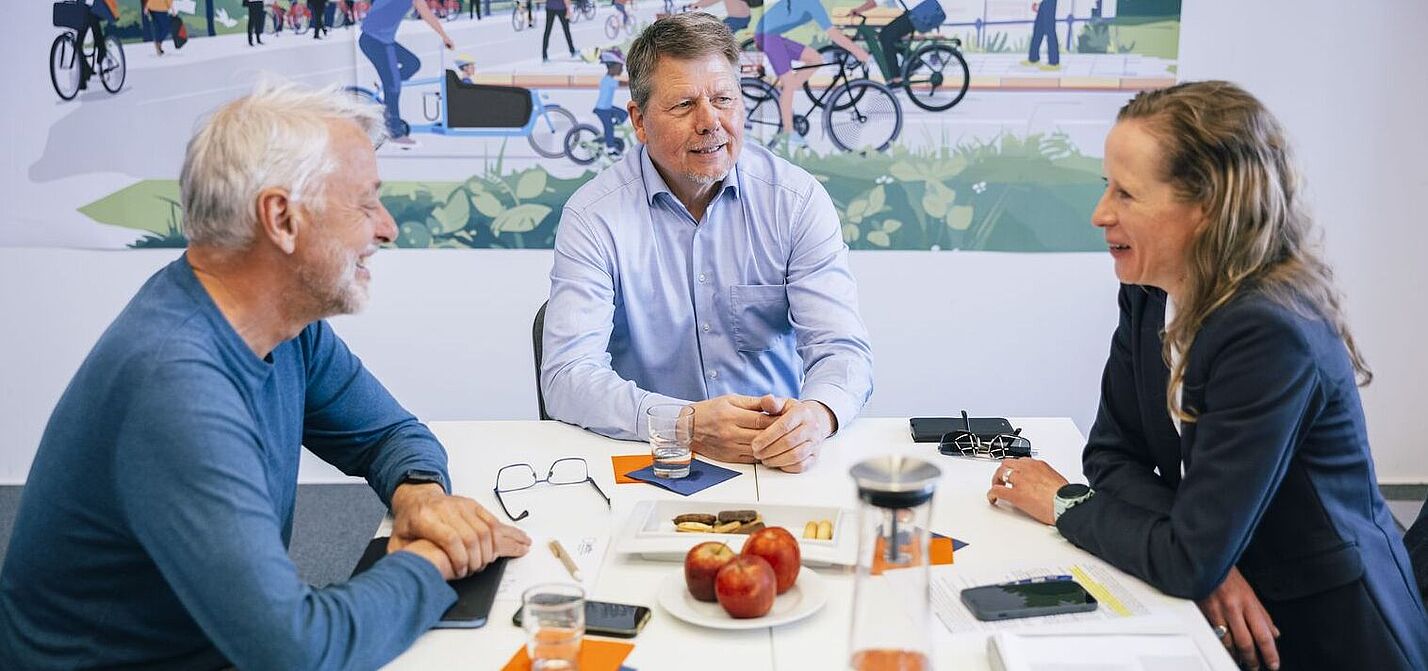
Frank Masurat, Dr. Joachim Lohse und Dr. Caroline Lodemann (v. l. n. r.) diskutieren die ADFC-Vision Fahrradland-Plus. © ADFC/Deckbar Photographie
Mobility Needs To Be Simple and Safe
The ADFC has a vision: the Bicycle-Friendly Country Plus. We sat down with Frank Musurat and Dr Joachim Lohse, members of the ADFC Federal Board, and Dr Caroline Lodemann, Director of Political Affairs within the ADFC, to talk about the vision.
The road traffic law reform has been completed - for now. How satisfied is the ADFC?
Frank Masurat: The reform was a multi-year process that nearly failed, but has now been successfully concluded for the time being: the German Road Traffic Act, Road Traffic Regulations and the Administrative Provisions to the Road Traffic Regulations have all been reformed. What is still missing from the legislation is Vision Zero (no fatalities in road traffic, ed. note) and 30 km/h as the default speed limit in built-up areas. We will therefore continue to advocate for the further development of the German Road Traffic Regulations, so that municipalities can, for example, establish school streets and superblocks on a legally secure basis. We also want to further improve road safety — for example through safer intersections. Overall, we count the reform as a major lobbying success for the ADFC. The ball is now in the court of the municipalities — they have to take action.

On the one hand, mobility has to meet the needs of all people, while the transport sector must be climate-neutral by 2045 on the other. Cycling is a serious lever in this regard and must be considered from the outset in all transport infrastructure investments."
Dr. Caroline Lodemann is the ADFC's Executive Director. Following the collapse of the coalition government, she worked together with the Federal Board and the specialist department at the National Office to further develop the ADFC vision 'Cycling Nation Plus'.
Vision Zero keeps coming up in ADFC communications. But what does it actually mean?
Caroline Lodemann: Vision Zero doesn't just keep coming up at the ADFC - it is also mentioned as a goal within the coalition agreement of CDU/CSU and SPD. That alone isn't enough, of course; a vision won't bring itself to life. Infrastructure must be redesigned and funding must be made available. A modern mobility system that is guided by Vision Zero takes into account that people make mistakes. It is planned and designed to prevent accidents, so that as few people as possible are killed or seriously injured. Children and older people, as well as pedestrians and cylcists, are given special protection. This requires a forgiving infrastructure that feels safe and comfortable for people of all ages. The system guarantees safe and relaxed mobility for all, while at the same time remaining efficient. We believe that the Cycling Nation Plus is exactly this kind of mobility system.

How did the ADFC come up with the Bicycle-Friendly Country Plus concept?
Joachim Lohse: For the 2021 federal election, we drew up the Cycling Nation Germany action plan to support the federal government in its work. Because we needed reliable figures, we commissioned a study to identify the potential of cycling for climate protection and modal shifts.
The study was conducted by the Fraunhofer Institute for Systems and Innovation Research ISI and shows that Germany can become a cycling nation by 2035 (see box p. 9), if existing measures to promote cycling are significantly intensified and municipalities are redesigned to be more cycling-friendly. This would not only improve mobility — it would also significantly increase quality of life and the functionality of cities and regions. At the same time, a large share of transport-related greenhouse gas emissions could be saved.
Using the results of the study, we expanded our action plan to create the Bicycle-Friendly Country Plus vision. We are convinced that Germany would genuinely benefit from more bicycle traffic,future-proof structures and a model infrastructure with safe and comfortable cycling networks covering the entire country: this will help commuters on their way to work, or shift how employees commute; at the same time, cycling tourism can boost the economy is rural and structurally weak areas, while making municipalities much more worth living in.

We believe that the National Cycling Planshould be made binding through an implementation agreement between the federal government, the states, and municipalities. If all parties pull together, the measures contained within the plan can certainly help achieve the national and international goals in the transport sector."
Frank Masurat has been the ADFC's Federal Chair since November 2023. He believes we can improve the cycling infrastructure through demonstrations and campaigns to raise public awareness as well as through discussions and negotiations with experts.
Following the collapse of the coalition between FDP, SPD and Bündnis90/Die Grünen, the ADFC has sharpened its demands. What are they?
Frank Masurat: We have four core demands. First: a federal mobility plan that includes all modes of transport — including cycling and walking. The plan draws on the National Cycling Plan, which was initiated in 2019 and with which the federal government committed to achieving to seamless cycling networks, sufficient bicycle parking, and cycling-friendly conditions by 2030. However, implementation has been lacking. The ADFC therefore calls, as its second demand, for a binding agreement between the federal government and the states to ensure the implementation of the National Cycling Plan. Our third demand is to expand the cycling infrastructure seamlessly across Germany without gaps — and to roll out the 'German Cycle Network' for everyday use and tourism. This of course requires robust funding. Our fourth demand is therefore that the new federal government restructures the financing of the traffic infrastructure through an infrastructure fund.

Building and maintaining the cycling network is a responsibility shared by the federal government, the states, and municipalities. However, there is a lack in coordinated planning and statutory regulations that would offer the states and municipalities lasting support to finance the cylcing infrastructure.
Dr. Joachim Lohse as the former Senator for the Environment, Construction and Transport in Bremen, Dr Joachim Lohse knows the pitfalls of federal funding and financing for transport projects and their impact on the states — and brings a "dash of practical experience" to the Bicycle-Friendly Country Plus vision.
What are the advantages of an infrastructure fund?
Joachim Lohse: The financing of cycling infrastructure is — as in the transport sector as a whole — in need of reform. There is a massive investment backlog everywhere, including in cycling. Funds must therefore flow into the maintenance, modernisation, and new construction of cycling facilities.
Currently, we have many funding programmes with very different durations, funding rates, and conditions. Their volume often fluctuates with annual budget negotiations. As a result, the timeframes are too short to actually draw down the funds. This does not create planning security — it creates stagnation. And the gap between the federal states is growing: funds flow to the wealthier states that have drawers full of project-ready plans, while the poorer states get nothing.
We therefore propose establishing infrastructure funds with fixed financing pillars for all modes of transport over several years. This is also something that the state transport ministers repeatedly call for, as continuous funding creates planning security. Clear definitions around the criteria and objectives around how funds are to be used also ensures a high degree of transparency.
Building and maintaining the cycling network is a shared responsibility of the federal government, the states, and municipalities. However, there is a lack of coordinated planning and a statutory regulation that would enable the federal government to provide lasting support to the states and municipalities in financing cycling infrastructure. This too is part of our proposals.

Speaking of which: the National Cycling Plan 3.0 is set to run until 2030. So far, however, little of the strategy has been implemented…
Frank Masurat: We are actually envied internationally for our National Cycling Plan, as it is a solid foundation. While it does lack binding force, it could easily be developed into an implementation concept for the Cycling Nation and Beyond, if a) the responsibilities of the federal government, the states, and municipalities are clearly defined and b) the financial resources are aligned with actual needs.
We believe that the NRVP should be made binding through an implementation agreement between the federal government, the states, and municipalities. If all parties pull together, the measures contained within the plan can certainly help achieve the national and international goals in the transport sector.
When the ADFC revised its demands after the collapse of the coalition government, the multi-billion-euro special fund for Germany was not yet on the horizon. Does the package change anything about the ADFC's demands?
Caroline Lodemann: The special fund must be invested wisely and sustainably in the future. Mobility is a sector that urgently needs to be developed further and has great potential: On the one hand, mobility has to meet the needs of all people, while the transport sector must be climate-neutral by 2045 on the other. Cycling is a serious lever in this regard and must be considered from the outset in all transport infrastructure investments.
People want to reach their destinations affordably, safely and in a climate-friendly manner. How well people can reach workplaces, schools, train stations and other destinations is central to the competitiveness of municipalities and their economic success. Employment, prosperity, and social participation are the glue that holds our society together. It will be a challenging task to do justice to all of these factors — but politics must achieve this swiftly, with the help of experts from all areas of transport.

What does the ADFC's vision look like in practice?
Caroline Lodemann: As the ADFC, we naturally advocate for more and better traffic - including because we know and can demonstrate that the bicycle is a solution to many problems. This, however, is taken into account far too rarely. At present, planning and investments are purely reactive and do not aim to shape the future or search for new approaches - yet policymakers could actively steer conditions through concepts for traffic calming, health promotion, and physical activity.
The Deutschlandticket (editor's note: rail ticket that allows users to travel anywhere in Germany, using regional trains) has put an end to complicated rate systems and made public transport more attractive. When it comes to taking bicycles on board, however, many different fares and restrictions still apply. It would be simpler if the Deutschlandticket were extended to include, for example, an additional, bookable bicycle option. We also need good, safe, and covered bicycle parking facilities at train stations and stops, as not everyone wants to take their bicycle on buses and trains.
The coalition agreement says little about cycling. Is that a good or a bad sign?
Joachim Lohse: The coalition agreement states that cycling and walking will be strengthened and promoted as part of sustainable mobility. That's a good thing - but now is not the time to do things by halves: the cycling paths alongside federal roads need expanding, and the financing needs to be right. We expect the government to produce a draft agreement between the federal government and the states as well as financing concepts within its first 100 days. The agreement should create a binding commitment to implement the National Cycling Plan.

Ten Reasons for a Cycling Nation Plus
1. Free-flowing traffic and reduced congestion
2. An attractive economic location for everyone based on a modern infrastructure
3. Improved road safety and fewer lives lost
4. Safe school routes and child-friendly communities
5. Healthier citizens through active, everyday mobility
6. Outstanding quality of life and a more relaxed way of living
7. Cleaner air and climate-friendly transport
8.Thriving cycling tourism as a boost to regional economies
9. Affordable mobility and stronger social cohesion
10. Small investments with a big impact on the cycling traffic infrastructure

The potential of cycling
Germany has the potential to triple cycling traffic across all regions, thereby creating more space on the roads. Car traffic in municipalities could be halved if the share of people taking the bicycle on journeys of up to 30 kilometres rises to 45 per cent by 2035. This would save 19 million tonnes of CO₂ equivalents annually.
The key prerequisites for this are:
1. An inviting cycling infrastructure: Tripling and improving cycling networks across Germany — separated safely and comfortably from car traffic.
2. Cycling as part of the sustainable transport mix: when cycling is well integrated into public transport, with train stations and stops that are easily accessible by bike and available, modern bicycle parking facilities, the potential for shifting away from car traffic increases further.
3. Cycling-friendly municipalities: Cities and towns that promote sustainable transport and encourage people to cycle more through shorter routes are safer and more enjoyable to live in than cities that continue to prioritise the car.


